Sunday, March 10, 2013

Feng Shui Tattoo Symbolism

FENG SHUI TATTOO SYMBOLISM


Feng shui symbols were used for centuries in feng shui because of the power of symbols and associations, as well as their historical associations. If a certain feng shui symbol does not resonate with you, choose one that does. Make it work for you, express the energy you need, and bring good feng shui into your life. What is important to understand is that, in order for feng shui to work i, you do not necessarily have to apply traditional Chinese symbols. You have to apply culturally specific symbols that resonate with you. 


You should use the energy of symbols that you are familiar with; in other words, the symbols that you emotionally respond to. 

What is very important to understand is that, in order for feng shui to work, you do not necessarily have to apply traditional Chinese feng shui symbols. The energy you need can be expressed in endless ways


Most of us are familiar with the look of many feng shui items such as the Chinese coins tied with a red string, the three legged toad, the dragon, the gods of wealth, etc. 


The reason symbolic level of feng shui works is because of the energy specific symbols bring into your tattoo, as well as because of their connection with the subconscious level of your mind. The stronger your connection with these symbols, the more you like them, the more powerful they become for you.


Popular Chinese feng shui symbols:


Love & Marriage Feng Shui
    • Double Happiness Sign: There is perfect symmetry, flow and balance in the Chinese double happiness sign, which speak of the possibility of a lasting harmonious energy in a love relationship. 
    • Dragon  is a powerful and auspicious traditional feng shui cure and an excellent feng shui symbol of strong yang / male energy. A pearl, or a crystal, in the feng shui dragon's claw symbolizes wealth, power and an abundance of opportunities.

      As a popular feng shui cure, dragons come in many sizes and variations of materials and color. A green dragon, for example, is an excellent feng shui cure  health  while a golden dragon can be a great feng shui cure for wealth and abundance.
    • Dragon and Phoenix The dragon & phoenix pair is a classical feng shui cure for keeping (or attracting) the energy of harmonious communication in a marriage. In most representations, the dragon & the phoenix form a dance, or a circle of two energies that resembles the yin yang symbol.

      Historically, there are many specific elements that add to the power and the good luck associations of the dragon & phoenix symbol in Chinese culture. This couple is the most powerful motif in all Chinese imperial design. 
      As both the dragon & the phoenix are mythical creatures, they can be represented in slightly different ways, depending on artists' vision, as well as specific associations
    • Mandarin Ducks If you grew up in China or Japan, where the Mandarin ducks are wide-spread - you most probably have heard stories about the love and devotion of Mandarin ducks. They mate for life and are considered loyal and devoted to their chosen partner.

      Because in symbolic feng shui level one works with images and symbols to represent the desired energy, the Mandarin ducks have become the perfect feng shui cure for love. That is, in Chinese culture. Does that mean you have to use it? If you like it, certainly go for it; if you do not feel the love attraction when you look at the Mandarin ducks, rest assured there are hundreds of images out there that can speak to you of love and devotion. 
    • Peony Flowers  The universal language of flowers crosses any cultural boundaries, interpretations or meanings. The feng shui use of the flowers symbol is based on the same universal feeling that flowers evoke in all humans - a feeling of beauty, grace, and a delicate, alive sensuality. 
    Wealth Feng Shui
    • Gold Arrowana or Koi Fish The symbology of fish, in general, is closely associated with the energy of water. The mysterious, the unknown, the bringer of life - all these (and more) are associations with the power of the waterelement. Feng shui adds the dimension of prosperity and abundance to the meaning of water. So, to put it in very simple terms, water is a life giver, thus a symbol of continuous abundance, and the fish would be a giver of sustenance, or nourishment, thus sure associated with health, wealth and prosperity. 
    The symbol of fish was celebrated as sacred in many cultures and in many stages of human history - from Greek and Roman mythology to the worlds of Celts, Hindu, Buddhism and Christianity. 

    In Chinese culture the symbol of fish is generally attributed two qualities. The first one is the aspect of abundance (because of the above mentioned qualities, as well as the ability of fish to quickly reproduce in quite big quantities). Then, of course, the Chinese word for fish (yu) is pronounced the same way as abundance! The other, less known aspect of Chinese fish symbology, is the fidelity and good companionship association, because many fish swim in pairs. 
        • Arowana is undeniably the most prized fish for feng shui wealth purposes. Also called the dragon fish (because of its scales, as well as overall look though to be similar to the Chinese dragon); live arowanas can command quite high prices. Some of the fish behaviour can explain its wealth associations, too; arowanas are known to grow very fast, as well as become quite dominant/more powerful while getting older. In feng shui, arowana is used not only as symbol for wealth, but for power and authority, too. As compared to other feng shui fish, arowana is usually depicted alone.

        • Koi is the next prized fish in the feng shui world. A decorative variety of carp, koi come in several bright colours such as red, yellow, blue, white and sometimes black. The typical number for Koi fish in a feng shui is 9 (8 brightly coloured koi and 1 black koi fish). The black fish is there to neutralize bad luck. You can also find feng shui cures with 2 koi fish, this being a feng shui cure to attract love and fidelity. There are also painting with any number of koi fish in a stream, which is used to represent a fresh flow of abundance. Still, best numbers are considered either 9 or multiples of 9.

        • Goldfish are sometimes confused with koi because there is some similarity between them. Their application is also very similar to koi fish. The golden colour of the goldfish brings the desired association with gold and the gracious movement creates good energy. The feng shui number rules for the goldfish are the same as for the koi.

    Good Fortune and Protection Feng Shui
    • Chinese Unicorn (Chi Lin) is a mythical Chinese creature with the head of a Dragon, the body of a Horse, and the scales of a Carp fish. Also called the Dragon Horse, or the Chinese Unicorn, Chi Lin brings strong, protective feng shui energy with blessings of good health and prosperity
    • Fu Dogs   or Imperial Guardian Lions, are a strong feng shui protection symbol. Fu Dogs were also a traditional feng shui symbol of family wealth and social status.

      Fu Dogs are usually displayed as a couple. The male Fu Dog is holding a globe under his right paw, which signifies control over his domain and protection of his home. The female Fu Dog is holding a cub under her left paw, signifying strong maternal protective instincts.

      It is interesting to note that the lion is not an animal indigenous to China. History says that travelers brought stories about lions as a Buddhist protector of Dharma, and statues of lions were modeled in feng shui after the travelers' descriptions and after the native dogs. 
    • Red Bat The bat is considered an auspicious classical Chinese feng shui symbol of good fortune and prosperity. In classical feng shui applications Bat is considered a symbol of wealth and used as a wealth cure because the same word/pronunciation for Bat - "Fook" - also means "Prosperity" in Chinese. Bat also came to represent happiness and longevity, so it is an auspicious symbol in Chinese culture. 
    • Tortoises  are considered guardians of good feng shui energy and the roots of their symbolism and feng shui use go deep to the feng shui beginnings. The are used as a protection and energy strengthening cure when placed on your back. A black tortoise, as a feng shui energy enhancer for your career - it will help attract a smooth, grounding energy for your business projects and promotions in your career. Used to bring a stable, protective, grounding energy. There are also feng shui tortoises with specific designs on their back, as well as feng shui terrapins, which should not be confused with feng shui turtles, as their feng shui use is slightly different.
    • Various Flowers, such as Orchids, Cherry Blossoms
    • Peony  One of the most sensual flowers with a delicious scent, the peony has long been used in feng shui as a cure for love & romance. This especially applies to a couple of pink peonies. The symbol of peony is often considered a metaphor for female beauty.
    • Lotus  The lotus flower symbolizes the ultimate perfection; its purity is not touched by the mud from which it originates. In Chinese medicine, every part of the lotus plant, from roots to petals, has medicinal properties, thus making this symbol an even more potent feng shui cure for health and harmony .
    • Cherry Blossoms  The blossoming flowers of cherry, as well as apple, dogwood, peach or other similar trees, have always been used to bring the energy of new beginnings, a sense of freshness and innocence. Most often the image of cherry blossoms is used as a love & marriage cure, but can also be used as feng shui cure for health.
    • Orchid   This beautiful flower is considered a classical feng shui symbol of fertility. The orchid bringing the energy of an untainted natural symmetry, it has also become a symbol of a quest for perfection in any areas of one's life. Abundance, perfection, spiritual growth, beauty and purity - with such powerful universal symbolism attached to it, no wonder orchids have become a very popular house plant in the West! 
    • Narcissus  In Chinese culture the structured energy of the narcissus flower is believed to bestow the flowering of one's career, talents and abilities. It is often used as a feng shui career cure, believed to help one get proper rewards for his or her hard work. White color narcissus is used more often in feng shui career applications versus the yellow one.
    • Chrysanthemum  The feng shui symbol of a chrysanthemum flower is one of a life of ease and balance. At the same time, this flower is considered to have strong yang energy, so it is used to attract good luck to you.
    • Mystic Knot Symbol is one of the most often used symbols in feng shui. Being a combination of six times the infinity symbol, this feng shui knot symbolizes a long and happy life full of good fortune. Mystic knot is sometimes referred to as the endless knot, because it looks like it swallows its own tail.

      In Buddhism, the mystic knot is one of the 8 magical auspicious objects. This symbol implies there is no beginning and no ending, reflecting Buddhist philosophy of endless rounds of birth and rebirth. As a feng shui cure, the mystic knot represents a harmonious flow of auspicious energy uninterrupted by any setbacks, accidents or misfortunes.

      It is believed that the presence of the feng shui mystic knot will benefit every aspiration of your life, thus this feng shui symbol is often used in feng shui amulets for love, abundance, feng shui protection , feng shui for career
    •  Horse brings the energy of success, fame, freedom and speed. 
    Health, Longevity & Happiness Feng Shui
    • Butterfly Symbol The most common feng shui use of the butterfly symbol is as a feng shui cure for love and romance, probably because love is the most transformative feeling that makes you feel like flying.It can help energize the free flow of creative energy in your life and gracefully guide you through the transformational stages in your life,  
    • Sau, the God of Longevity Long life, fame and fortune - these highly sought after attributes are believed to be brought into any space by Fuk Luk Sau, the three feng shui gods of wealth. As with most feng shui cures, the Fuk Luk Sau, or three feng shui gods of wealth, are there to bring what humans keep aspiring for through centuries - wealth, power and good luck, in addition to healthy and long life.
    • Lucky Bamboo  Bamboo in itself is an amazing plant that brings a very peaceful and wise energy. It teaches the ultimate wisdom: how to be flexible and hollow (open) on the inside, so that the spirit can freely flow and heal your being.
    • Images of Birds
    • Phoenix   The mythical Phoenix is the most famous bird in feng shui, and it is often paired with the Dragon as a feng shui symbol of marital happiness. On its own, the Phoenix has Yang energy, when paired with the Dragon it symbolizes Yin, or female energies. The Phoenix symbolizes the energy of great strength, resilience and transformation, as it is able to raise form its own ashes to reach greater heights. The feng shui element associated with the Phoenix is Fire. 
    • Cranes  The Crane comes next after the Phoenix in its popularity in feng shui applications. The Crane came to symbolize longevity because of its long lifespan. In ancient Chinese legends, the Cranes carry the spirits of the departed to the heavens. Thus, the symbol of cranes is used in feng shui to bring the energy of a long, noble and peaceful life that will eventually lead the human soul to heavens.
    • Mandarin Ducks These famous ducks are the "love birds" of feng shui, as they are the most popular traditional feng shui cure for love & romance. Because they mate for life, the Mandarin ducks came to symbolize devotion, fidelity and lifelong affection in the matters of the heart. Mandarin ducks are always used in pairs
    • Peacock  Stunning in its beauty, the Peacock is considered the manifestation of the celestial Phoenix on earth. Its mesmerizing colors and the "thousand eyes" look on its tail is considered to promote fame luck in feng shui, as well as enhance one's protection and awareness. Of course, such a stunningly beautiful bird as peacock will also symbolize beauty and the feelings of love and attraction, thus the image of peacock or the peacock feathers are often recommended in feng shui as a love cure for single people to help attract the desired mate.
    • Rooster  The Rooster is often used in feng shui for career advancement purposes, because the same Chinese word used for the official is also used for the Rooster's chest. No matter which culture you come from, though, if you watch Roosters you will notice that they tend to be quite bossy.  The Rooster wakes up very early and announces the dawn of a new day/the dispersing of darkness and dark spirits, so the Rooster also came to symbolize the ability to ward off evil spirits.
    • Magpie   In feng shui, the magpie is associated with joy, celebration and happiness. It also symbolizes the tendency for nesting, so the image of a magpie is a traditional feng shui cure recommended for those who want to settle down and "nest". Magpies are also associated with marriage, children and happy households.   In ancient China, the arrival of magpies was regarded as an auspicious omen of new opportunities, be it a new job or a new love. The symbol of magpie is often used as a traditional feng shui cure to help remove, or alleviate one's obstacles in career or love life.
    • Doves   Peace is the universal energy of doves, no matter which culture one comes from. In feng shui, doves are also sometimes used as a love cure to promote a long and peaceful marriage. One of the Chinese legends affirms that doves were highly favored at the Emperor’s court because of the calming effect of their cooing.
    • Buddha brings a peaceful, calm and comtemplative energy in a busy, hectic lifestyle 

    • Various Fruits, such as Peaches, Apples, etc. The feng shui energy of fruits is the energy of fruition. The use of specific fruits in traditional feng shui applications is often dictated by classifications from ancient texts as being specific symbols of longevity, wealth, prosperity, fertility, etc.

        • Peach. One of the most popular feng shui fruit symbols, peach is the symbol of immortality. The peach is also known in feng shui as the fruit of heaven because of its prominence in many ancient Chinese legends about the Immortal gods. Peach came to be associated with wealth, health, abundance and longevity. The peach is also known as a feng shui symbol of love and marriage. In China, "love luck" is often referred to as "peach blossoms luck".

        • Pomegranate. Because the pomegranate is full of juicy seeds, it symbolizes fertility in feng shui and it is used as a feng shui fertility cure. Pomegranate also symbolizes happiness in the family, as well as good luck for one's descendants. 

        • Grapes. In feng shui, grapes symbolize abundance of food, thus abundance of material wealth. Grapes came to represent success and abundance coming to one in the near future, or always being in one's family. Sometimes grapes are also used as a feng shui symbol, or cure for fertility, as well as a cure for turning bad luck into good luck.

        • Apple. Apple has always been associated with peace, good health and harmony in one's home. One of the reasons is the fact that in Chinese language the word for "apple" sounds like the word for "peace". Color-wise, red apples are considered to be very auspicious, although or course green and golden/yellow apples are also widely used according to their color properties.

        • Pineapple. The sound of the Chinese word for pineapple is close to the sound of “good luck coming your way”, so the pineapple has become a popular traditional feng shui symbol of wealth, fortune and prosperity.

        • Oranges. The popularity of oranges in the traditional feng shui applications is explained by the refreshing/cleansing odor, as well as the yang quality of the orange color.  It is believed that citrus fruits can ward off bad luck, thus oranges, along with tangerines and limes are often used in traditional feng shui.



    Thursday, July 5, 2012

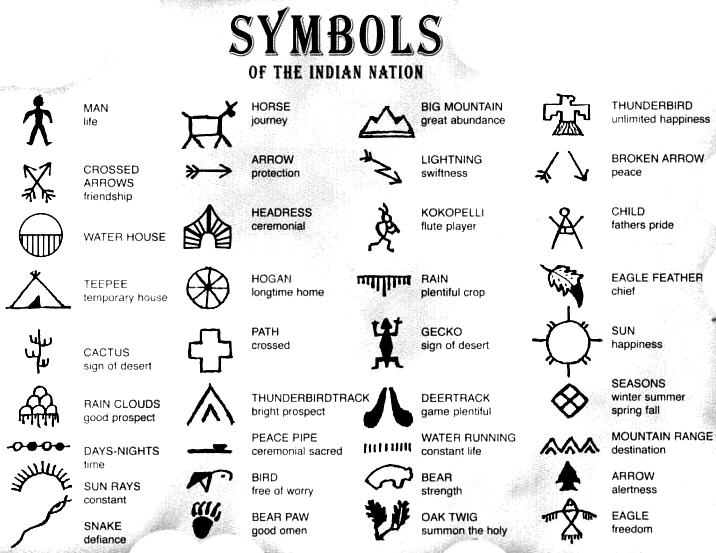
    Native (Indian) Symbolism


    NATIVE AMERICAN INDIAN SYMBOL MEANING


    KOKOPELLI FLUTE PLAYER....According to the many stories about him, this humped-back flute player has a bag of songs on his back and is said to travel from village to village.  His songs bring fertility to the crops, to women who desire to have children; he entertains the children and his songs also bring healing and love.

    BEAR....power, protection and strength
    EAGLE....strength, courage, wisdom and keen sight
    WOLF....a guide, intelligence, steadfastness, protection
    BUFFALO....abundance, generosity, strength, survival
    HUMMINGBIRD....joy, healing, soul carrier or sunkisser
    ARROW....protection
    ARROWHEAD....alertness
    GILA MONSTER....sign of the desert
    HORSE....swiftness / journey
    SNAKE....defiance / wisdom
    DEER TRACK....plenty game
    MAN....human life
    LIGHTENING ....spirit
    LIGHTENING ARROW....swiftness
    WATER WAVES....constant life


    Indian Animal symbolism


    Animals Used in Indian Symbolism

    Alligator - Survival, strength and aggression.

    Avanyu - the feathered skysnake - Frequently found in Tewa, Keres and Zuni pottery and in some jewelry. He is the storm bringer, the changer of seasons. Connected with lightning, thunderstorms and violent, sudden change.

    Antelope - Symbolized partnership, grace and speed.

    Badger - Fierce hunters and honorable healers. Also have spiritual powers. Their tracks may signify health and strength as well as a way of summoning the power of the animal spirit, or as an indication of the presence of the spirit. Badgers are revered as healing animals and as tenacious hunters. Their tracks may signify health and strength. Bear Paws/Tracks are also symbols of authority and leadership. 

    Bear - Symbolized steadiness, patience, pragmatism, balance, big hearted and secure, first helper, direction protector from the west Bear Paws are usually considered a way of summoning the power of the animal spirit, or as an indication of the presence of the spirit. Bear Paws/Tracks are also symbols of authority and leadership.

    Beaver - Symbolizes busy, in charge, efficient, strategic, wit and untiring.

    Birds - Bird feathers represented creative ideas, honor and prayer.

    Buffalo - Symbolically and realistically prized and equated with medicine and honor. The buffalo signified all good things such as sacred prayer, goodness, reverence and honour.

    Bull - Represented richness in life, wealth, courage and strength.

    Crane - Symbolized the end of the growing season.

    Cricket - Symbolizes a singer, is connected with springtime, fertility and water.

    Deer - Represents speed, alertness, institution, purity, sense of humor, quick wit and protector. Deer Tracks, are symbols of prosperity, safety, shelter, and also of the proximity to prey. Also used as a directional indicator, and as a clan symbol. 

    Dragonfly - Connected with water and Springtime, fertility, renewal; considered a messenger.

    Coyote - Symbolized a powerful prey animal, an excellent tracker, associated with unpleasant happenin, a trickster.

    Eagle - Symbolized as one who carries prayers, vision, possesses courage, wisdom and directioal protector close to the gods The master of the sky. The eagle is often confused with the "thunderbird" image concept. Almost universally, the Thunderbird as a Native American symbol conveys concepts such as: Power, provision, expansiveness, transformation, divine dominion, indomitable spirit, unquestioned authority and messages from the other worlds.

    Elk - Represented freedom, majesty, power and stamina.

    Feathers - Symbols of prayer, ideas, honor, creativity.

    Falcon - Symbolized a natural leader, clear judgment, efficient, effective, active, persistent, passionate and compassionate.

    Fox - Symbolized intelligence, elusiveness, cleverness, cunning and discretion. Also the fox was symbolic of feminine "magic," and still is!

    Frog - Symbolized fertility, the coming of the spring and renewal.

    Goose - Symbolized ambition, business sense, staying power or driven.

    Horned Lizard - Symbolizes lizards. Significant in some Navajo stories connoting perseverance and keeping ancient secrets. They are also used in story telling to be an annoyance to the Coyote!

    Horse - Symbolized purity, nobleness, courage, power, independence of spirit, freedom to roam and pride. Horses were also used to attribute special qualities that people possessed such as the ability to be sympathetic, loving and giving--always offering a helping hand.

    Hummingbird - Symbolized as ferocious fighters and defenders. Represented devotion, the cycle of life, permanence and eternity.

    Moose - Symbolized wisdom, spontaneity, integrity, stubbornness, positive self-image and unpredictability.

    Otter - Symbolized honesty, unconventional behavior, effective, imaginative, intelligent and perceptive.

    Owl - Warm, changeable, enjoys life to its fullest, good listener, a teacher, an excellent hunter. Can be excessive and mean at times. Some tribes associate the owl with death and darkness. Among the Zuni and Keres Pueblo people, the owl is respected as the guise of departed, wise elders and leaders' spirits. 

    Parrot - Symbolized the coming of the rainy season and the sun, spiritual, symbol of beauty. Parrots were considered carriers of these specific prayers and would confer blessings. Kept for their feathers and color, by many Pueblo people (secured through trade with people to the far South), and also considered a very expensive posssesion thereby denoting prosperity.

    Pheasant - Represented a warning sign. Silver feathers of the pheasant symbolized prosperity.

    Quail - Symbolized in mated pairs: devotion, permanence, eternity and the life cycle. These are often modified in many simple forms.

    Raven - Symbolized enthusiasm, charm, energy, creative ideas, idealism, diplomacy and ingenuity. Also symbolized vindictiveness and abrasiveness.

    Salmon - Symbolized focused, purposeful, goal oriented, intuitive, creative, stable, a motivator and different.

    Snake - Symbolized spiritual, healing powers, passionate, fertility, lightning, speed and stealth.

    Tadpole - Immature frogs that connote fertility and renewal. Because they change, they are considered very powerful.

    Turkey - Represented resourcefulness, freedom, courage, sustenance (food for life) and faith. The turkey is mentioned in several Tewa Pueblo stories. Its feathers have many ritual uses.

    Turtle - Symbolized strength, fertility, long life, and staying power. Considered to be able to defy death, and is also an annoyance to Coyote.

    Water Birds - Symbolized renewal of life, wet seasons, rivers distant travel, long vision, wisdom. often inaccurately called "thunderbird", which is not a Southwestern tradition, but rather one of the plains people. In that context, connected with lightning, thunder and visions. Those who dream of the thunderbeings must become Heyokas -- those who live out their dreams backwards (Lakota tradition). The image has also been modified and used as the symbol of the Native American Church, founded by Commanche Quannah Parker around 1910.

    Wolf - Symbolic of a tracker, directional finder, leader, loyalty, intuition, a problem solver, stability communicative skills and teacher. Wolf Tracks, or any other predators tracks usually signify a direction rather than simply the spirits presence. These also are a clan short hand indication of kinship - "wolf clan", for example. Also symbols of authority and leadership.

    Woodpecker - Symbolic of a nurturer, listener, empathizer, supporter, organizer, and resourceful. Frugality is also symbolic of the woodpecker.


    Native American Hopi Symbolism

    Native American Hopi Symbolism

    Hopitu-shinumu (Hopi) means Peaceful People; this serves as a background to understanding their use of symbols.

    The Hopi are expert craftspeople, and possess uncommon agricultural skills.

    Their connection with the land, cultivating, and harvesting is truly superior. Specifically, their ability to skillfully coax yielding corn from the desert sands is to be commended. This connection to earth, and nature is constantly exhibited in Hopi symbols.

    A few Hopi symbols and their meanings are provided here with an aim to bring about understanding and respect to these diverse and skillful people.

    Hopi Maze SymbolMother Earth or Maze Symbol:


    This is a common symbol among many Native American tribes, including the Hopi.

    One of its representations is that of mother and child, the connection of earth mother to us as her children.

    The beginning, straight center-line represents the child – or our philosophical beginnings – the surrounding maze represents the enfolding energies of mother earth.

     Note the maze does not enclose the center –line representing the child. The symbolism then is strong when we realize the support of the mother is constantly around yet our ability to venture out on our own is always there.


    Hopi World Symbol:

    This symbol signifies world to the Hopi The "cosmic cross" or four bars represent north, south, east and west correspond to the outermost points on the horizon where the sun passes through the year; the solstice and equinox points.

    The four circles inside the outer outline represent the four nations (the first four tribes of mankind), which came to the world to keep balance.


    Hopi Sun Symbol:
    A symbol of creative and natural energy.

    The supreme god due to the Hopi's dependence upon it for the growth of corn, and other sustaining crops.

    The sun symbol represents the heart of the cosmos and deals with vitality, growth, and passion.


    Hopi Spiral SymbolHopi Spiral Symbol:


    This rendition of the Hopi spiral is also common among North, South and Central Native American Indian tribes.

    The spiral represents the number of journeys or treks a tribe or nation has made to the four corners of the earth.

    Engraved on stones, the spiral suggests an intricate journey made to the Otherworlds on back.
    Generally, the spiral represents a broadening of consciousness, which is the destination arrived after a long journey.


    Hopi Kachina Sun SymbolHopi Kachina Sun Symbol:

    Also known as a Tawa kachina, it is a spirit symbolizing of life, growth, strength of spirit, and abundance.

    The likeness of this spirit is donned during the solstice ceremony to beckon the sun's return, and begin the growing season.


    KOKOPELLI....According to the many stories about him, this humped-back flute player has a bag of songs on his back and is said to travel from village to village.  His songs bring fertility to the crops, to women who desire to have children; he entertains the children and his songs also bring healing and love.

    Tuesday, April 24, 2012

    Star Tattoo Symbolism


    Star Symbolism


    The star symbolizes honor, achievement, hope, divinity, intuition, the feminine and guidance.


    For centuries, the symbol of the star has been used to reference  divinity, intuition, the feminine, hope and guidance.  Stars offer the ability to guide us through the night. They can also refer to your need to discover their own inner light.  Stars exists above us as well as within us. They encourage us to trust in something much greater than ourselves.
    One of the most popular associations to the Star is its reference to our aspirations, dreams and hopes. They represent our ambitions and desires. They remind us that when things may appear to be out of our grasp, through diligence and faith we can travel beyond our current limitations. 


    Fivepointed star :


    without crossing lines is also one of the most common and important Western ideograms. It is used in the flags of some 35 countries, both Western and Eastern. Its first appearance on a national flag is believed to have been in 1777, when the United States of America declared itself an independent country. 
    This star is also the most widely used military symbol and is found on the tanks and fighter jets of all the superpowers, as well as in the armed forces of all other countries on officers and petty officers' uniforms.  For nearly all armed forces on this planet the golden fivepointed star without crossing lines is the symbol par preference of military rank and power.

    It is also the sign for the planet Venus as the Morning star and the goddess of war

    Stars with wavy points are emblems of God's goodness, or some other eminence that elevated the first bearer above the common people. 

    Stars, estoiles and mullets are often confused because of their similarity, which is not helped by the fact that no definite lines have ever officially been followed regarding their specific differences. 

    In England
    Estoliles: stars with wavy rays are called estoiles
                An estoile can have any number so one must be provided 

    Mullets: when "stars" have straight lines they are called mullets.
               A mullet has five points unless another number is specified, which it often is.

    So technically there is no such thing as a star in English symbolism. 

    In Scotland 
    The distinction between a mullet and a star is that a mullet is pierced, which actually makes it a spur-revel, and a star is whole. 


    In France
    The definition of a mullet is different yet again; this time, it has no less than six points.


    A star depicted on a coat of arms, in some cases, may represent a falling star and denote a divine quality bestowed from above, whereby men shine in virtue like bright stars on the earth.


    SIX-POINTED STAR:


    Six-pointed star formations are rare as an ideograph in Western cultures except in the case of law enforcement badges. 

    In astrology some formations of a six-pointed star can signify fixed stars. In some rare instances it can signify the date of birth on a gravestone, synonymous with the five-point star.

    If the collinear edges of a regular six-pointed star are connected, so that two interlaced triangles are formed, a symbol results that is variously known as the hexagram, Star of David, or Shield of David (Magen David). This symbol is most commonly associated with Judaism; it is also used in Christianity and Islam and Hinduism, but on a less frequent basis. The six-points represent all twelve patriarchs (Vav or Man) or tribes. The two "Triangles" are actually the letters "Dalet" and "Yud", the two letters assigned to Judah. The two triangles form a diamond, which is the gem assigned to Judah. These letters are found in the assigned zodiac of Leo.

    Several varieties of six-pointed stars are used in Western culture:
    • The Star of Life, which is a six-armed cross
    • German and German-American hex signs and barn stars often incorporate both five- and six-pointed stars as central themes.
    • The six-pointed star is used as the symbol for Folks Nation alliance of gangs from Chicago. Crip gang members tend to use this symbol also.

    When surrounded by a circle, it represents the "divine mind" (a counterfeit of God's wisdom) to numerous occult groups through the centuries. Many still use it in occult rituals. But to Jewish people, it is their Star of David. 


    Nautical Star 


    In the five-pointed star, a line is drawn from each point to split it into half and each section is filled with an alternating color. The colors used for the nautical stars are either red and black, or green and black. The sailors would usually get two nautical stars tattooed. The port side, which is the left side of the ship is represented by the red and black nautical star tattoo, while the green and black star tattoo is used to represent the starboard side or right side. Those who served the port side of the ship had the red star while green star was for those who served the starboard side of the ship.

    Sailors donning a red and black nautical star was linked to their pride as it meant that the sailor had traveled across the Pacific ocean at least thrice. That was a great achievement in itself. Some of them got a red and black nautical star tattoo as the compass at the bottom of most of the sea maps was colored red and black. Since sailors completely relied on celestial navigation in those days, the North Star being a fixed reference point was a great aid. These nautical star tattoos were also symbolic of hope. They got these tattoos to ensure safe passage. Since the sailors were staying away from their loved ones, they hoped to reach back home safely to reunite with their dear ones. Their beliefs about the nautical star stemmed from their dependence on the celestial navigation to get back home.


    The nautical star tattoos were earlier a symbol of hope and guidance for sailors. A nautical star was a symbol of hope and good luck. It may give one strength to succeed in life. 


    Nautical star tattoos have also been linked with the gay or lesbian movement and punk rockers.


    Shooting Star


    symbolizes a brief fleeting moment in ones life just like the brief wonder of seeing a shooting star race across the night sky. 

    They can also be a symbol of reaching ones ultimate destiny.
    Traditionally shooting stars also meant a new birth and changes in ones life and also a wish for a better life.


    Celtic and Irish Cross Tattoo Symbolism


    Celtic Cross and Irish Cross Symbolism


    Symbolism of the Celtic Cross

    The Celtic Cross was a symbol of the four quarters
    North, which represents wisdom, stability, and winter
    East, for knowledge, learning, and spring
    South for vitality, passion, strength, and summer
    West, representing intuition, emotion, and inner knowledge
    The circle connecting the four arms of the Celtic cross symbolizes the unity and the eternal cycle of life and rebirth.


    Also it's four arms were perfect for denoting
    The four elements
    The four directions of the compass
    The four parts of man - mind, body, soul and heart. 
    The addition of the ring around the cross has many explanations, including sun worship


    The Celtic Cross had it's evolution in the British Isles, with it's earliest form dating to approximately the ninth century and appearing mostly in Ireland. This early version is called a recumbent cross-slab, and they lied flat rather than standing upright. Eventually these made their way into an upright position (now called erect cross-slabs), and acquired a slightly rounded top. Both versions were often decorated with key patterns, interlaced knotwork, and spirals

    The celtic cross then underwent another change. Extraneous rock was carved away from the head of the slab, leaving the rock with the outlined shape of a tall cross, usually on a wider base. Because the cross form was in effect "freed" from the rock now, these types of crosses were commonly called erect free-standing crosses. From these, the arms of the cross eventually became extended beyond the ring of the cross, and the inner quadrants between the rings and the arms were cut away or recessed from the rest of the cross design. The free-standing crosses were elaborately made, and often composed of several pieces of stone. A large cross could have been made of up to four pieces of stone (the base, the shaft, the head, and the upper cross arm), held together by mortise and tenon joints carved into the stone. 

    An Irish legend tells how St. Patrick created the first Celtic cross by drawing a circle over a Latin cross to incorporate a pagan moon goddess symbol. 

    For an Irish Catholic, the circle in the Celtic cross may be a symbol of eternity and the endlessness of God's love. It can even represent a halo emanating from Christ.


    The celtic cross and Irish cross shape itself has been widely used by many ancient peoples, long before the arrival of Christianity. 


    Irish Claddagh Tattoo Symbolism


    The Hand Signifies Friendship, the Crown Loyalty, And the Heart Love.

    The Claddagh's distinctive design features two hands clasping a heart, and usually surmounted by a crown. The elements of this symbol are often said to correspond to the qualities of love (the heart), friendship (the hands), and loyalty (the crown). A "Fenian" Claddagh ring, without a crown, was later designed in Dublin. Claddagh rings, with or without the crown (most commonly with a crown), have come to denote pride in Irish heritage, while continuing to be symbols of love or marriage.

    The Irish Claddagh consists of two hands holding between them, or presenting, a heart.  Over the heart is a design representing a crown or fleur de lis.  The phrase or posy, that usually accompanies the ring is: "Let love and friendship reign."

    The original expression which accompanied the passage of the "Claddagh" was:  "With these hands I give you my heart and I crown it with my love."

    There is an old tradition in Ireland that goes with wearing a Claddagh ring.   If you wear your Claddagh ring with the heart facing outwards it means that your heart is available.  If you were the Claddagh Ring with the heart facing inwards it means that your heart has already been taken by someone.

    Also it is said that a  Dublin version of Claddagh Rings appeared about 100 years ago with two Hearts and two hands and No Crown. This is the Fenian Claddagh 
    It is growing in popularity because of its unique design, its peculiar history, its sentimental appeal and its close association with the ancient Claddagh of Galway.

    The Claddagh symbol is commonly used as friendship symbol, but are most commonly used to represent engagement/weddings. 
    In Ireland, America and other places, the Claddagh is handed down mother-to-daughter or grandmother-to-granddaughter. 


    Placement:

    Engagement ... by placing the tattoo on the left side your body wtih the heart pointing outwards indicates you are spoken for

    Wedding (married)...represented by placing the tattoo on the left side of your body wtih the heart pointing inwards towards your heart


    Friendship... by placing  the tattoo anywhere on your right hand side.